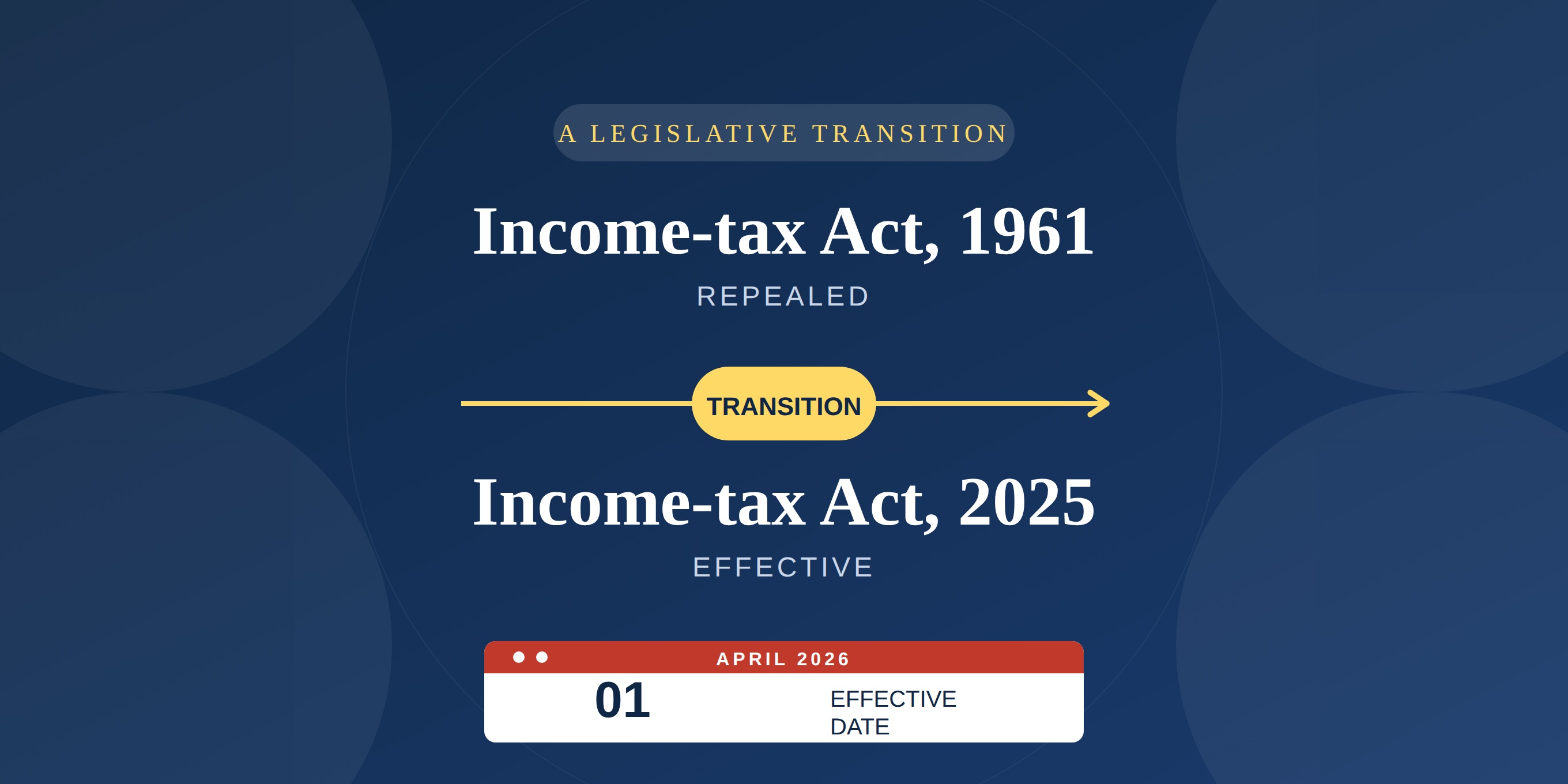
The transition from the Income-tax Act, 1961 (ITA 1961) to the Income-tax Act, 2025 (ITA 2025) — effective 1st April 2026 — marks a structural shift in India's direct tax regime. While the legislative intent is to simplify and modernize tax administration, the changeover inevitably raises several practical and interpretational challenges for taxpayers and professionals alike. Understanding the transitional provisions under the Income-tax Act, 2025, particularly Section 536, is therefore essential for every assessee and practitioner navigating this phase.
Quick Snapshot: Key Takeaways
Repeal Date: The Income-tax Act, 1961 stands repealed with effect from 1st April 2026.
Governing Provision: Section 536 of the ITA 2025 — the "Repeal and Savings" clause — is the central pillar of the transition.
CBDT Guidance: The Central Board of Direct Taxes issued comprehensive FAQs in March 2026 addressing practical transitional issues.
PAN, TAN & Approvals: All existing PANs, TANs, registrations, and approvals granted under the old Act continue to remain valid under the new Act.
Pending Proceedings: Assessments, appeals, reassessments, and penalties relating to tax years before 1st April 2026 will continue to be governed by the ITA 1961.
Fallback: Where Section 536 is silent, Section 6 of the General Clauses Act, 1897 governs the effect of the repeal.
Recognizing these concerns, the Central Board of Direct Taxes (CBDT) issued a set of Frequently Asked Questions (FAQs) in March 2026. These FAQs aim to address key practical issues, provide clarity, reduce uncertainty, and facilitate a smooth transition within the statutory framework. Tax professionals are advised to refer to these FAQs whenever difficulties arise in interpretation, operation, compliance, or assessment under the new law.
At the heart of the transitional framework lies Section 536 of the ITA 2025, titled "Repeal and Savings." This provision is structured into 4 sub-sections, with sub-section (2) alone containing 22 sub-clauses, each addressing a distinct transitional situation — ranging from pending proceedings, carry-forward of losses and credits, continuation of approvals and elections, to the treatment of search and amalgamation cases. Together, these sub-clauses comprehensively preserve rights, obligations, and procedural continuity between the two Acts.
However, in cases where Section 536 does not expressly cover a situation, recourse must be taken to Section 6 of the General Clauses Act, 1897, which governs the effect of repeal of statutes. Sub-section (4) of Section 536 expressly incorporates this fallback, ensuring that no transitional gap is left unaddressed.
A key aspect of continuity is that existing PAN and TAN will remain valid under the new regime. Similarly, approvals, registrations, and recognitions granted under the ITA 1961 shall be deemed to have been granted under the ITA 2025, ensuring administrative and procedural continuity.
Despite these clarifications, several practical issues arise in day-to-day practice. Some of the important scenarios are discussed below:
1. Applicable Appeal Forms
Where an appeal is to be filed in May 2026 for Financial Year 2023–24, the question arises whether the new Form No. 99 or the old Form No. 35 is applicable. As per Section 536(2), the old Form No. 35 will apply. The determining factor is the provision under which the order appealed against has been passed.
2. Issuance of Notices for Past Assessment Years
If a notice is to be issued after 01.04.2026 for Assessment Year 2024–25, it must be examined whether the provisions of ITA 1961 or ITA 2025 apply. Section 536(2) clarifies that such notices shall be issued under the ITA 1961, i.e., under sections like 148 or 143(2), as applicable.
3. Set-Aside Proceedings by ITAT
Where the Income Tax Appellate Tribunal (ITAT) sets aside a matter for Assessment Year 2023–24 after 01.04.2027, the proceedings before the Assessing Officer (AO) will continue to be governed by the ITA 1961, based on the principle embedded in the transitional provisions.
4. Consolidated Orders for Assessment and Penalty
A notable procedural change is the requirement for consolidated orders covering both quantum assessment and penalty. Interestingly, this requirement applies even in transitional cases, as amendments have been made in both Section 274(4) of the ITA 1961 and Section 471 of the ITA 2025 to align this position.
5. Search Proceedings Initiated Post Transition
In cases where a search is initiated on or after 30.05.2026, the six-year assessment period will be governed by the provisions of the ITA 2025. Section 536(2)(v) specifically provides that the new Act shall apply in such cases.
6. Concept of Abatement
The concept of abatement continues to be relevant in search and reassessment proceedings. Its application under the new regime must be understood in light of both the repealed and the new provisions.
7. Adjustment of Refunds
Under the ITA 1961, Section 245 governs the adjustment of refunds against outstanding demands, while Section 438 of the ITA 2025 provides the corresponding mechanism. Both provisions have been suitably amended to ensure seamless adjustment of refunds during the transition phase.
8. Taxation of Capital Gains under Transitional Provisions
Consider a case where a capital asset is transferred in December 2023 and the net consideration is deposited in the Capital Gains Account Scheme. If the funds are not utilized within the stipulated period up to December 2026, the taxability in Tax Year 2026–27 becomes an issue. The applicable rate—whether 20% under the old regime or 12.5% under the new regime—must be determined with reference to Section 112 of the ITA 1961, Section 197 of the ITA 2025, and specifically Section 536(2)(h), which governs such transitional situations.
9. Changes in Compliance Forms
Another important area is compliance through forms. Under the ITA 1961, Form 26QB was used for reporting TDS on property transactions. Under the ITA 2025, the new Form 141 has been introduced, which is structured based on the number of buyers, indicating a shift in reporting methodology.
10.Carry-Forward of Losses and MAT/AMT Credit
One of the most practically significant transitional concerns relates to brought-forward losses and accumulated tax credits. Clauses (m) and (n) of Section 536(2) expressly provide that losses brought forward for tax years beginning before 1st April 2026 — whether business losses, capital losses, house property losses, speculation losses, or losses from specified business — shall continue to be carried forward and set off under the ITA 2025 in the manner prescribed under the corresponding provisions of the repealed Act.
Importantly, the original character of the loss is retained (no reclassification), and the carry-forward period continues to run from the original assessment year — the eight-year clock does not restart. For instance, an eligible business loss of AY 2023–24 can be carried forward into the new regime, but its total carry-forward period cannot exceed eight years counted from AY 2023–24.
Similarly, accumulated MAT credit under Section 115JAA and AMT credit under Section 115JD of the ITA 1961 are preserved and are deemed to be eligible credits under Section 206 of the ITA 2025, available for set-off in subsequent tax years subject to the prescribed conditions. Unabsorbed depreciation carried forward under Section 32(2) of the old Act is automatically merged into the opening capital allowance pool under Section 33(11) of the new Act for Tax Year 2026–27 and beyond.
A word of caution: while the carry-forward survives by virtue of Section 536, the utilisation in future years will be governed by the computational framework of the ITA 2025. Practitioners must therefore evaluate each loss item by reference to both its source provision under the old Act and its corresponding treatment under the new Act.
11. "Tax Year" Replaces "Previous Year" and "Assessment Year"
A fundamental terminological shift under the ITA 2025 is the replacement of the dual concept of "Previous Year" and "Assessment Year" with a single, unified concept — "Tax Year". The Tax Year is aligned with the financial year (1st April to 31st March), thereby eliminating the long-standing confusion between income-earning and assessment periods.
To bridge this terminological change, Section 536(3) specifically provides that any reference in the ITA 2025 to a tax year commencing on or before 1st April 2025 shall be construed as a reference to the corresponding "previous year" under the repealed Act. For example, "Tax Year 2024–25" under the new Act corresponds to "Previous Year 2024–25" under the old Act, which in turn relates to "Assessment Year 2025–26".
This is purely a drafting and terminological alignment — it does not alter the tax treatment, computation, or compliance applicable to those years. However, practitioners must be mindful of this construction while drafting submissions, replies, and appeals straddling both regimes.
Conclusion
The transition from the ITA 1961 to the ITA 2025 is not merely a legislative change but a structural transformation. While Section 536 provides a robust framework to address most transitional issues, practical challenges will continue to emerge. A careful reading of the statutory provisions, supported by CBDT FAQs and general legal principles such as those contained in the General Clauses Act, is essential for navigating this phase effectively.
Active professional engagement and discussion on these issues will go a long way in ensuring a smooth and informed transition to the new tax regime.
Q1. When does the Income-tax Act, 2025 come into force?
The new Act becomes effective from 1st April 2026, and the Income-tax Act, 1961 stands repealed from the same date.
Q2. Will my PAN and TAN remain valid under the new Act?
Yes. PAN, TAN, and all approvals/registrations granted under the 1961 Act are deemed to continue under the 2025 Act.
Q3. Which Act applies to a notice issued after 1 April 2026 for AY 2024–25?
As per Section 536(2), such notices shall be issued under the Income-tax Act, 1961, since they relate to a tax year prior to the commencement of the new Act.
Q4. What is the difference between Form 35 and Form 99?
Form 35 is the appeal form under the 1961 Act; Form 99 is its successor under the 2025 Act. The applicable form depends on the provision under which the original order was passed.
Q5. Has Form 26QB been replaced?
Yes. Under the 2025 Act, Form 141 replaces Form 26QB for TDS on property transactions, with structural changes based on number of buyers.
K.K. Singla (Advocate)
President Patiala Tax Bar Association
98140-93274






Comment:
Post An Query
Due Dates
BookMark
Send Email
BookMark
Send Email